One of the most important parts of non-destructive testing inspections is detecting and evaluating the linear surface indications in welds. Linear indications are in many industry codes and standards highly critical and are normally defined as rejectable defects. Due to this, it is vital to use inspection methods that can reliably detect and characterize these defects in order to preserve weld integrity and asset reliability over the long-term.
Common methods of inspecting surface defects include visual inspection, magnetic particle testing and penetrant testing. Although these methods of measurement are still widely employed, they can be time consuming, skill dependent on the operator and require a great deal of interpretation to be able to correctly classify the indications that are seen during examination.
As the advanced non-destructive testing technologies have evolved, inspection teams have at their disposal more ways of enhancing their crack detection and characterization. The advanced inspection techniques that are used aid the service provider in creating more accurate inspection reports and assist asset owners in making more informed decisions about maintenance and operations.
Heat Affected Zone cracking (HAZ Cracking)
Toe Cracking is the cracking of the material near the weld area, which is also called Heat Affected Zone (HAZ) cracking. These cracks tend to occur under the following three conditions:
- The availability of adequate amount of hydrogen
- A substance that can be broken.Something that can be broken or cracked.
- High levels of stress
The occurrence of heat affected zone cracking can be reduced or eliminated if one or more of these contributing factors are eliminated. Often these cracks occur after the welded material has cooled, which is why it is particularly important to check welded material after welding.
Basic inspection techniques may be inadequate to detect heat affected zone cracks, as they can start at the weld toe and extend into the surrounding base material. This renders reliable surface and near surface examination methods very useful.
Transverse Cracking
Transverse cracking – cracks that occur perpendicular to the direction of the welding travel inside the weld metal. Transverse cracking occurs less frequently than other types of crack but is frequently related to weld metal with higher strength properties than the surrounding base material.
However, hydrogen can also play a part in this type of cracking, and transverse cracking is often associated with high levels of residual stress and a crack sensitive microstructure. Transverse cracks are mostly found in the weld metal and are caused by longitudinal stresses applied to the weld, as opposed to heat affected zone cracks.
These cracks may affect the integrity of welds and their performance, making an accurate characterization a crucial part of inspection activities.
Crater Cracking
Crater cracking is a result of welding operation being terminated before the completion of the weld pass. This leaves a crater at the end of the weld, which may be subject to cracks when the weld cools.
Backfilling techniques are one of the common methods to minimize the risk of cracking of the craters. The thickness of the crater area can be increased before the weld is completed to reduce the possibility of cracks forming.
Correct welding processes and post-welding examinations are of critical importance in detecting and avoiding any defect caused by cratering.
Improved Surface Crack Detection with Advanced NDT Techniques
With continuing development of the non-destructive testing technology, inspection methods are increasingly capable and able to detect and size complex types of weld defects. Using advanced technologies, inspectors are able to gain a more thorough understanding of the characteristics of the cracks, which increases confidence in the results of cracking inspection.
Eddyfi Technologies is developing further inspection solutions that will offer comprehensive assessment for critical assets and infrastructure that need regular inspections.
The following are general technologies for flaw detection of welds:
- Phased Array Ultrasonic Testing (PAUT)
- Total Focusing Method (TFM)
- Eddy current Array (ECA)
All of these methods have their own particular benefits depending on the type of weld discontinuities being inspected and the needs of the inspection.
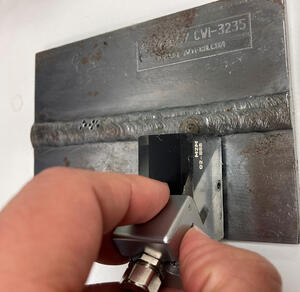
Phased Array Probe 64L5-G2
Phased Array Ultrasonic Testing and Total Focusing Method
The Total Focusing Method is another method similar to the phased array ultrasonic testing method that uses the same probes that are generally used on phased array ultrasonic testing systems, but with improved image quality and improved defect characterization.
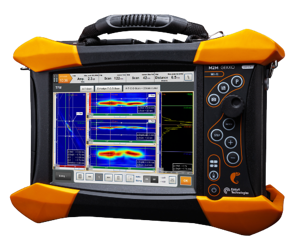
Gekko®
Gekko® is a field proven flaw detector for PAUT, conventional UT, TOFD and TFM inspection methods using the simple to use Capture™ user interface. The system comes in 32:128, 64:64 and 64:128 channel configuration options and offers high resolution imaging combined with rapid inspection rates, plus ease of operator training.
The system can be used to conduct advanced inspections with better imaging quality, allowing technicians to interpret indications and assess the properties of a flaw within a weld and critical component.
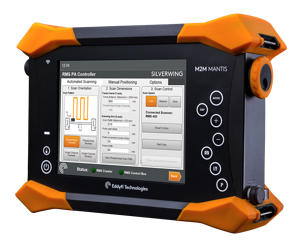
Mantis™
For UT, PAUT, TOFD and TFM inspections Mantis™ offers a lightweight and durable alternative. The system, available in several models, is built on a 16:64PR architecture, offering general purpose and advanced applications with no compromises in productivity.
Its small size is ideal for field applications requiring portability and flexibility.
Eddycurrent Array and Tangential Eddycurrent Array
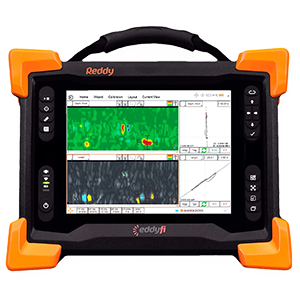
Reddy®
Reddy® is an electromagnetic inspection system that can be taken anywhere for fast crack and corrosion evaluation. The system features built-in data analysis software and is presented to the user with a large multi-touch display screen showing real-time C-scan images.
The technology provides the ability to perform rapid, reliable, high probability of detection surface inspections and enhances the efficiency of surface inspections in field applications.
Sharck™ Probes
Sharck™ probes were developed specifically for applications of crack detection in carbon steel materials with Tangential Eddy Current Array (TECA™) technology. These probes are able to accurately pinpoint cracks, measure crack length and size defects up to 7 mm (0.28 in. deep).
One of the great benefits of this technology is that it can be used to examine the surface without the need for paint or protective coatings to be removed, as many traditional surface inspection methods require.
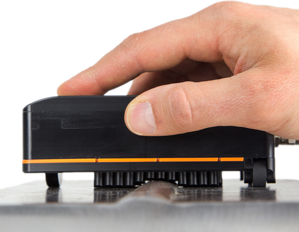
In a traditional pancake coil arrangement the coils are mounted across the test surface, while in the TECA arrangement the coils are mounted along the test surface. This helps the eddy currents penetrate beneath cracks more effectively, provided they can flow parallel to the surface of the material.
This makes the technique suitable for the detection and characterization of defects that are near the surface and/or on the surface.
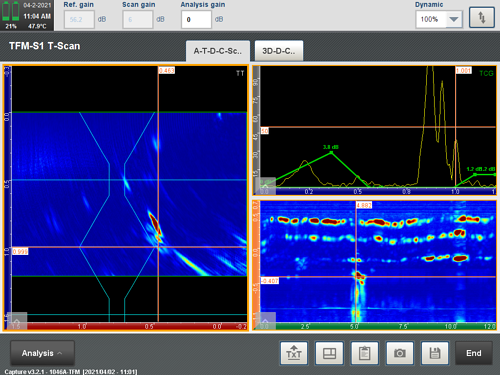
Total Focusing Method
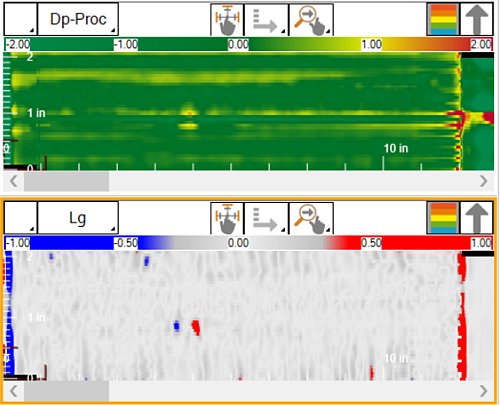
Eddy Current Array
Comparing Total Focusing Method and Eddy Current Array
The comparison between Total Focusing Method and Eddy Current Array technologies shows that both technologies have remarkable merits in detecting cracks of the HAZ and other weld discontinuities.
TFM is a highly detailed ultrasonic imaging technique to help accurately identify, characterize and size flaws, and Eddy Current Array techniques offer fast surface inspection with excellent sensitivity to small cracks.
Technicians can use advanced imaging with quick inspection times to better ensure the accuracy of their inspection process, and minimize uncertainty when evaluating the flaws.
In many applications, these technologies work together to yield more information on defect location, orientation and severity.
The following are some of the other advantages of advanced inspection techniques.
- The advanced inspection technology also brings several benefits to the operational side:
- Shorter inspection times than with some conventional methods
- Increased visualization and interpretation of defects.
- Improved repeatability and consistency of inspections
- Digital data recording for traceability and future analysis.
- Higher detectability of surface cracks with small dimensions.
- Improved condition monitoring and maintenance planning support
- Less subjectivity in interpretation alone
These benefits aid with better maintenance programs, asset integrity programs, and better decision making for maintenance and repairs.
These images compare TFM and ECA results of a weld plate.
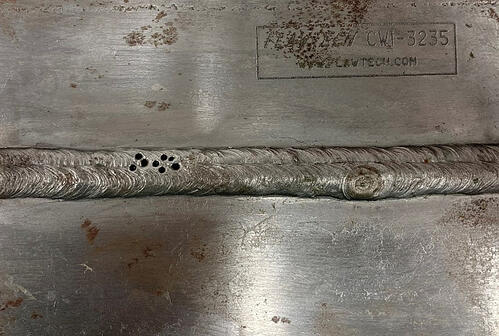
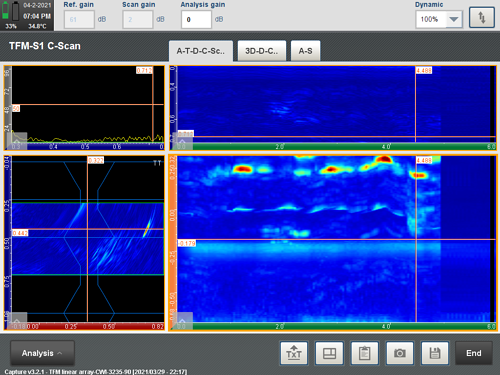
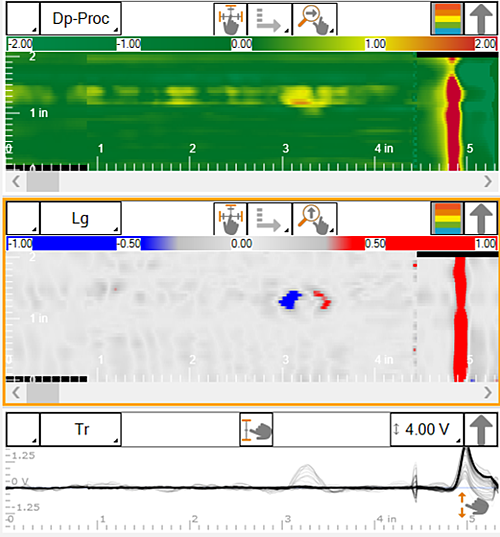
Finally, the following images show the results from the Sharck Eddy Current Array probe.
Conclusion
These examples illustrate the variety of advanced non-destructive testing techniques that can be used to detect transverse cracks and other cracks or discontinuities at the welds. While the skills and knowledge of the technician are still vital, new technologies like Total Focusing Method and Eddy Current Array allow for more precise and confident detection and characterization of defects.
These technologies enable the collection of imaging data, better detection and detailed inspection data that assist the technician in making an informed evaluation during weld inspection. Meanwhile, asset owners get more consistent inspection data that enables them to manage their assets more safely and effectively.
Using state-of-the-art NDT technology, coupled with professional and experienced inspectors, companies can obtain more accurate weld assessments and higher long-term integrity management for critical infrastructure and components.